
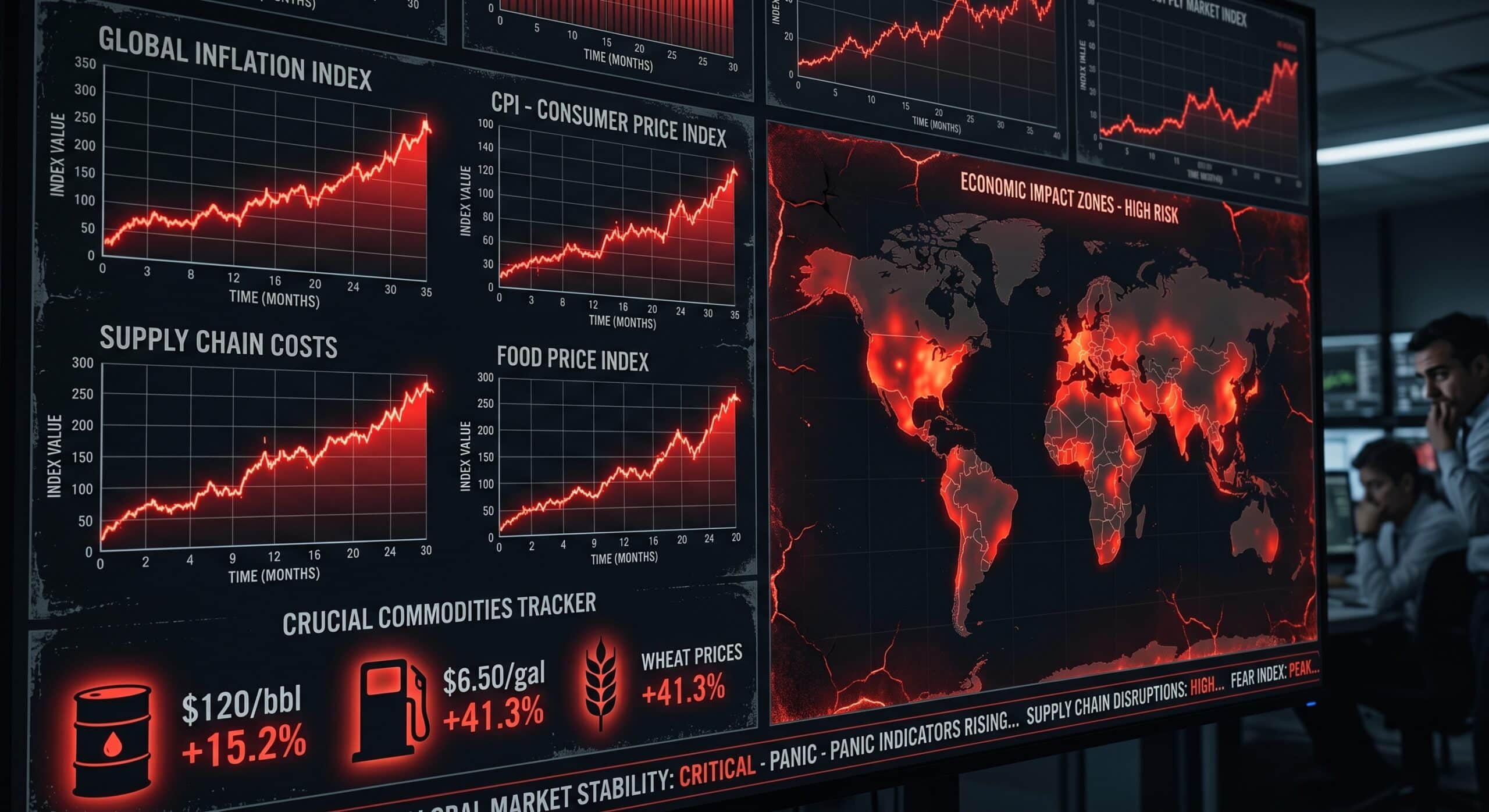
The Iran war economic impact has created what the IEA calls the greatest global energy security challenge in history. This guide covers every dimension of the Iran war economic impact — from the 55% surge in oil prices and 38% jump in US gas prices to the 140% spike in Asian LNG costs, food price inflation across developing nations, and the growing risk of global recession. Understanding the full scope of the Iran war economic impact is essential for investors, policymakers, and anyone affected by rising costs.
Iran War Economic Impact: The Global Fuel Crisis, Food Prices, and Recession Risk Explained
The Iran war economic impact has been felt in virtually every country on earth. The International Energy Agency has called the disruption caused by the 2026 US-Iran conflict the “greatest global energy security challenge in history.” From surging gas prices in America to cooking fuel shortages in South Asia, factory shutdowns in the Gulf, and food price spikes across Africa and the Middle East, the Iran war economic impact extends far beyond the battlefield.
This article provides a comprehensive data-driven overview of how the war has affected the global economy — energy markets, food supply, inflation, currencies, and the growing risk of recession.
Oil Price Surge
US Gas Prices
Asian LNG Prices
Iran Food Inflation
Iran War Economic Impact on Energy Markets
The energy sector has borne the most direct Iran war economic impact. The closure of the Strait of Hormuz removed approximately 20% of global seaborne oil supply and a significant share of liquefied natural gas (LNG) exports from the market. The IEA characterized this as the largest supply disruption in the history of the global oil market.
Oil Prices
Brent crude oil surged more than 55% from around $72 per barrel before the war to nearly $120 at its peak during the first two weeks of March. The March 2026 price increase was one of the largest monthly oil price surges on record. Even after the April ceasefire brought prices briefly below $100, the ongoing blockade and mine threat have kept prices elevated and volatile. For a detailed breakdown, see our oil price analysis.
Natural Gas and LNG
The LNG market was hit especially hard after Iranian strikes damaged Qatar’s Ras Laffan Industrial City complex on March 18, reducing Qatar’s LNG production capacity by an estimated 17%. Repairs are expected to take 3-5 years. Asian LNG spot prices increased by over 140% as a result. QatarEnergy declared force majeure on its contracts with buyers and reportedly began shutting down gas liquefaction facilities since LNG tankers could not leave the Gulf.
US Gas Prices
American gas prices have risen 38% since the war began, reaching a national average of $4.11 per gallon — the highest since the 2022 Russia-Ukraine crisis. Diesel has climbed even faster, up 49% to $5.62 per gallon. The West Coast has been hit hardest due to special gasoline blend requirements and limited pipeline connections to other regions.
Iran War Economic Impact on Food Prices
The Iran war economic impact on food prices has been severe, particularly in developing countries. The connection runs through several channels: higher fuel costs increase transportation and farming costs, fertilizer supply disruptions affect crop yields, and trade route closures delay food shipments.
- Fertilizer crisis: Qatar is a major producer of urea-based fertilizers. The damage to its LNG and chemical facilities has disrupted global fertilizer supply during the critical spring planting season. The UN allowed humanitarian and fertilizer shipments through Hormuz in late March, but volumes remain far below normal
- Iran’s internal crisis: Inside Iran, the war has caused food prices to surge dramatically — bread and cereals up 140%, red meat and poultry up 135%, oils and fats up 219%, and dairy products up 117% compared to a year ago. Rural areas have been hit hardest with 86.5% year-on-year inflation versus 69.3% in urban areas
- South Asian impact: India, which imports 60% of its LPG cooking fuel through the Strait of Hormuz, experienced immediate shortages. Long queues formed at fuel stations, and many households reverted to kerosene, coal, and wood for cooking. The Indian government cut excise duties on petrol and diesel by ₹10 per litre to limit consumer impact
- Global food security: The British think tank The Food Policy Institute has warned of long-term increases in food prices due to disruption in fuel and fertilizer markets. Countries in Africa and the Middle East that depend on imported grain and cooking oil face the most acute food security risks
Iran War Economic Impact on Global Trade and Shipping
Beyond energy and food, the Iran war economic impact has disrupted global shipping routes and trade patterns. The Strait of Hormuz closure forced shipping companies to reroute vessels around the Cape of Good Hope or through alternative ports, adding days to journey times and significantly increasing costs.
- Maritime insurance: War risk insurance premiums for Hormuz transit surged from 0.125% to over 1% of hull value, making transit prohibitively expensive even when technically possible
- Container shipping: Iran’s seizure of container ships in the strait has added a piracy-like risk element that has caused several major shipping lines to suspend Gulf operations entirely
- Houthi Red Sea attacks: Yemen’s Houthi forces launched attacks on Red Sea shipping in solidarity with Iran, creating a secondary disruption to the Suez Canal trade route that was already strained from 2024 Houthi attacks
- China’s economic exposure: China received a third of its oil imports through the Strait of Hormuz before the war. While China maintained approximately a billion barrels in strategic reserves (a few months of supply), the disruption has accelerated Beijing’s push for overland energy supply routes and renewable energy investment
Recession Risk and Inflation
The Iran war economic impact has significantly increased the risk of global recession and stagflation — a combination of economic stagnation and rising prices that is particularly damaging because traditional economic tools (interest rate cuts to boost growth, or rate hikes to fight inflation) work against each other.
Economic Warning Signs
- US inflation: The 38% gas price increase adds approximately 0.8% to headline inflation. The Federal Reserve faces a dilemma — cutting rates to support growth would worsen inflation, while keeping rates high would deepen the economic slowdown
- European energy vulnerability: Europe, still adjusting to reduced Russian gas supplies since 2022, faces a new energy crisis as Middle Eastern LNG supplies are disrupted. Analysts have noted the need for renewed North Sea investment and faster renewable energy transition
- Asian manufacturing: Countries like Japan, South Korea, and India that depend heavily on Middle Eastern oil face industrial slowdowns. Japan released 80 million barrels from strategic reserves — equivalent to 15 days of domestic demand — to mitigate the impact
- Emerging market currencies: Countries with large oil import bills have seen their currencies weaken against the dollar, increasing the cost of all imports and worsening inflation in a feedback loop
- Philippines energy emergency: On March 24, President Marcos declared a state of national energy emergency due to rising oil prices — one of several developing nations to take emergency measures
Iran War Economic Impact: Who Gains and Who Loses
Winners
- US oil producers: American energy companies benefit from higher global prices while producing domestically. The US is a net energy exporter, so while consumers pay more at the pump, producers earn more per barrel
- Russia: Moscow benefits from higher energy prices and reduced global supply, partly offsetting the impact of Western sanctions over Ukraine. Russian oil sales to India and China have increased as traditional Middle Eastern supplies are disrupted
- Renewable energy sector: The crisis has bolstered the case for renewable energy as countries recognize their vulnerability to fossil fuel supply disruptions. Solar and wind investments have accelerated
- Defense industry: Military spending commitments have increased across NATO and Gulf states
Losers
- Oil-importing developing nations: Countries like Pakistan, Bangladesh, Sri Lanka, and Philippines face the most acute pain — higher fuel costs, cooking fuel shortages, and food price inflation affecting the poorest populations
- Iran’s economy: The war has devastated Iran’s economy — mass layoffs, internet blackout disrupting online businesses, infrastructure destruction, and hyperinflation in basic goods
- Global consumers: Higher energy and food prices reduce purchasing power worldwide, with lower-income households bearing the heaviest burden
- Airlines and shipping companies: Longer routes, higher fuel costs, and increased insurance premiums have crushed margins
How Long Will the Iran War Economic Impact Last?
Even in the best-case scenario of a comprehensive peace deal, the Iran war economic impact will persist for months to years. The Pentagon estimates mine clearance in Hormuz could take 6 months. Damaged energy infrastructure in Qatar and Iran will take 3-5 years to fully repair. Supply chain disruptions, depleted strategic reserves, and elevated insurance costs will keep prices above pre-war levels for an extended period.
Track the economic situation in real time through our live dashboard with oil price tickers, Hormuz status, and daily SITREP reports covering market impact.
Track Economic Impact Live
Real-time oil prices, gas costs, Hormuz shipping status, and conflict dashboard.
Open War Intel Hub →