
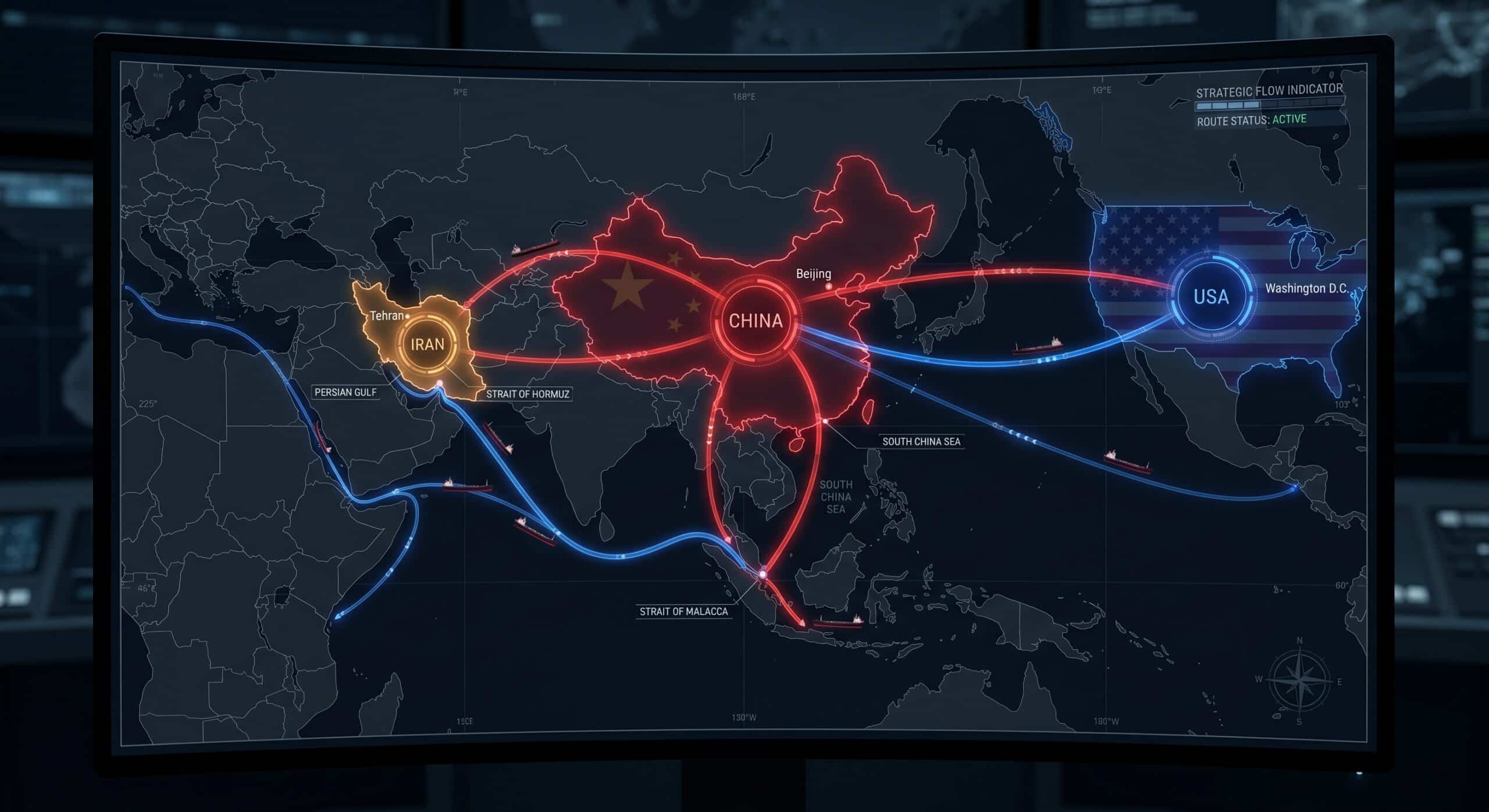
The China Iran war dynamic is reshaping global geopolitics. While Washington fights and Tehran suffers, China has emerged as the strategic winner of the 2026 conflict. This analysis examines how the China Iran war relationship works — from Beijing’s oil dependency on the Strait of Hormuz to its diplomatic positioning at the UN, South China Sea leverage, and growing influence across the Gulf states. Understanding the China Iran war connection is essential because the China Iran war reveals how the conflict is accelerating the shift in global power. The China Iran war strategy shows Beijing playing all sides simultaneously.
China and the Iran War: How Beijing Is Positioning Itself as the Conflict’s Biggest Winner
China and the Iran war have become one of the most analyzed geopolitical dynamics of 2026. While Washington fights and Tehran bleeds, Beijing has leveraged its economic relationships with all sides — the US, Israel, Iran, and the Gulf states — to protect its interests and expand its influence. Analysts increasingly describe China as the strategic winner of a conflict it did not start and has no intention of joining militarily. Understanding the relationship between China and the Iran war is essential for anyone tracking the broader geopolitical shifts underway.
China and the Iran War: The Strategic Position
Beijing has adopted a carefully calibrated position on the Iran war — one that preserves its relationships with both Washington and Tehran while positioning China as a responsible alternative to American military interventionism. China has called for an immediate ceasefire and diplomatic resolution, vetoed UN Security Council resolutions supporting the US position, and maintained economic ties with Iran where possible — all while avoiding direct confrontation with the United States.
President Xi Jinping has made his most explicit statements on the crisis, stating that the Strait of Hormuz must remain fully open for vessels, calling it a matter of shared international interest. But China has stopped short of any military involvement or direct challenge to the US naval blockade.
China’s Iran War Exposure
- Oil dependency: China received a third of its oil imports through the Strait of Hormuz before the war
- Strategic reserves: Approximately 1 billion barrels in reserve (several months of supply)
- Trade with Iran: China was Iran’s largest trading partner and oil customer before the conflict
- Trade with US: The US remains one of China’s largest trading partners despite tensions
- Gulf investments: Massive Chinese infrastructure investments across Saudi Arabia, UAE, and Qatar
China Iran War: How Beijing Is Gaining From the Conflict
Diplomatic Capital
China has positioned itself as a peace broker and voice of reason. By calling for ceasefire while the US prosecutes the war, Beijing has strengthened its standing with the Global South — the developing nations that make up the majority of the UN General Assembly. When the UNGA voted overwhelmingly for a ceasefire resolution, China was on the winning side while the US was among a small minority opposing. This dynamic mirrors China’s positioning during the Russia-Ukraine conflict but with even greater credibility since China has no military involvement in the Iran war.
Energy Diversification
The Hormuz closure has accelerated China’s push to reduce dependence on Middle Eastern oil transported through vulnerable chokepoints. Chinese investment in overland energy pipelines from Central Asia and Russia, deep-water port development in Pakistan (Gwadar) and Myanmar, and domestic renewable energy capacity has surged since the war began. The crisis validates China’s Belt and Road infrastructure investments as alternative trade routes.
Discounted Iranian Oil
China has historically purchased Iranian oil at significant discounts to market prices, often circumventing US sanctions through complex intermediary arrangements. During the war, with Iran desperate for revenue and most other buyers cut off, China’s leverage over Iranian oil pricing has only increased. If sanctions are eventually lifted as part of a peace deal, China would be positioned as Iran’s primary energy customer with established commercial relationships.
South China Sea Leverage
While US military resources are concentrated in the Middle East, China moved to block the Scarborough Shoal in the South China Sea — a strategic assertion that would have faced stronger US opposition if the Navy were not deployed to the Persian Gulf. The Iran war has provided China with a window of reduced US military attention in the Indo-Pacific, which Beijing has used to advance its territorial claims.
China and the Iran War: The Risks for Beijing
Despite the strategic advantages, the Iran war also poses risks for China:
- Energy security: The Hormuz closure affects China directly. While strategic reserves provide a buffer, a prolonged closure would strain Chinese industry and raise domestic energy costs
- Economic slowdown: Higher global energy prices contribute to inflation and reduced economic activity worldwide, including in China’s export markets. A global recession would hurt Chinese manufacturing and trade
- US pressure: Washington has asked China to help reopen the Strait of Hormuz. Refusal to cooperate could escalate US-China tensions at a time when both sides have been attempting to stabilize the relationship
- Mine warfare intelligence: As the US Naval Institute noted, China is closely studying Iran’s mine warfare tactics in the Strait of Hormuz for potential application in the Taiwan Strait — knowledge that concerns US military planners
- Gulf state relationships: Saudi Arabia, UAE, and other Gulf states have suffered economically from the war. If they perceive China as insufficiently supportive, it could affect Chinese investment deals worth hundreds of billions of dollars
India vs China: Competing Responses to the Iran War
India’s response to the Iran war provides an illuminating contrast to China’s approach. Both nations are major oil importers with significant economic ties to Iran. But while China has maintained diplomatic distance, India has taken more direct action — deploying naval destroyers to escort Indian-flagged vessels through the Gulf of Oman under Operation Urja Suraksha, summoning Iran’s ambassador after Indian ships came under fire in the strait, and negotiating directly with Tehran for vessel access.
India’s more assertive approach reflects its greater vulnerability — India imports a larger share of its energy needs and lacks China’s strategic reserves depth. The contrast highlights how the Iran war is reshaping the foreign policies of the world’s two most populous nations.
What China and the Iran War Means for the Post-War Order
The long-term significance of China’s positioning during the Iran war may exceed the immediate conflict. If Beijing emerges as a credible alternative to American leadership in the Middle East — offering economic partnerships without military intervention — it could fundamentally reshape the region’s strategic alignment. Several Gulf states have already been diversifying their security relationships toward China, and the Iran war has accelerated this trend.
However, China’s ability to project power to protect its Middle Eastern interests remains limited. Beijing cannot guarantee Hormuz access the way the US Navy can. The question is whether economic influence can substitute for military capability as the currency of power in the region — a question the Iran war may ultimately answer.
Follow the geopolitical dimensions of the conflict in our daily SITREP reports and track the economic impact in real time on our live dashboard.
Track the Conflict Live
Geopolitical developments, market impact, and verified intelligence.
Open War Intel Hub →