
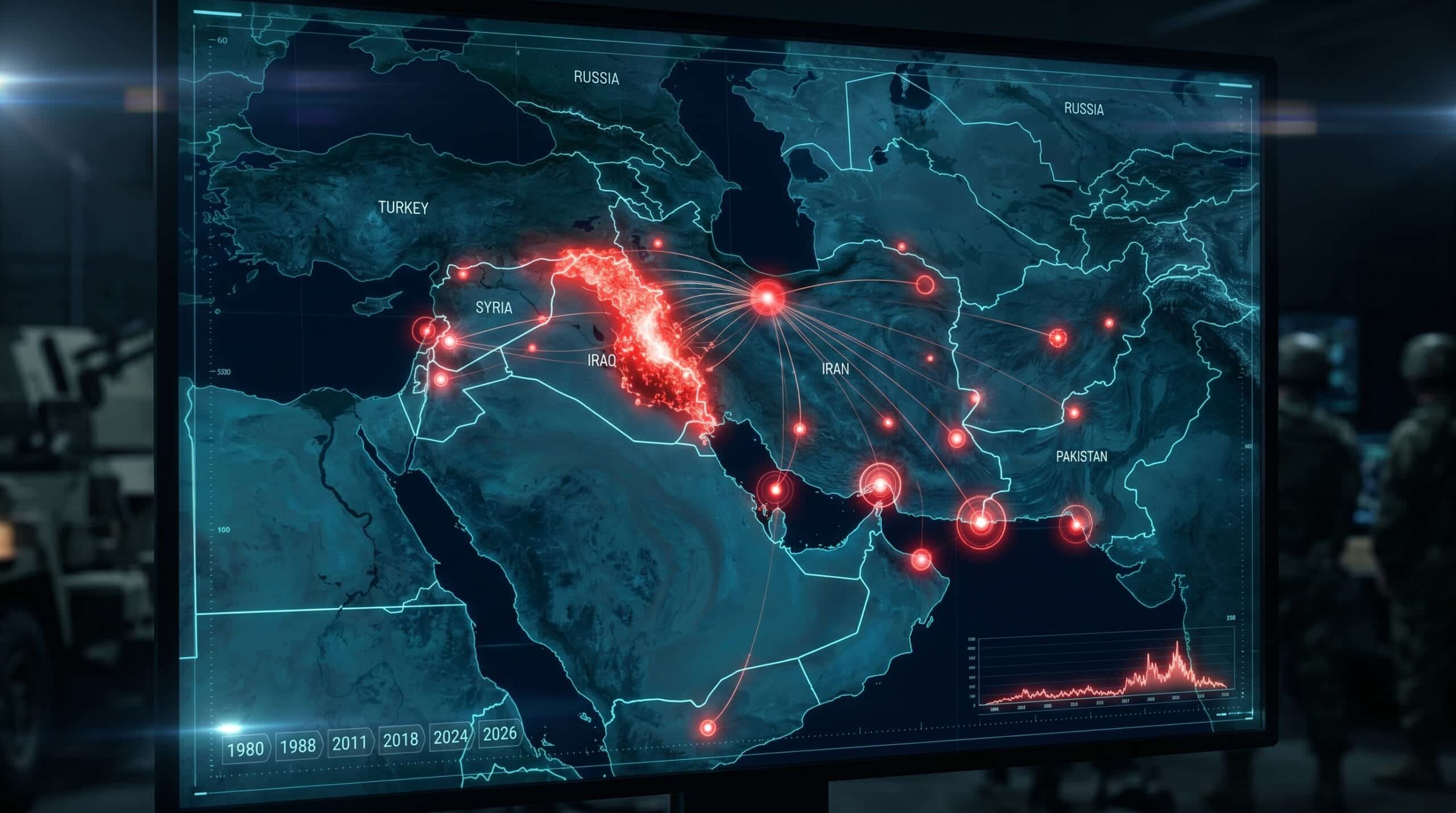
Iran Military History: Every War Since 1980 and Why the 2026 Conflict Is Different
Iran military history stretches across millennia, but the country’s modern military conflicts — from the devastating Iran-Iraq War to the 2026 US-Israeli strikes — reveal a pattern of escalation, adaptation, and asymmetric strategy that defines Tehran’s approach to warfare. Understanding Iran military history is essential context for anyone following the current conflict, because the 2026 war represents a fundamental break from everything that came before.
This article traces every major Iranian military conflict since the 1979 Islamic Revolution, explains how Iran’s military doctrine evolved through each one, and analyzes what makes the 2026 conflict genuinely unprecedented.
Iran Military History: The Major Conflicts
What Makes the 2026 Iran War Different From Every Previous Conflict
The 2026 conflict breaks from Iran military history in several fundamental ways:
1. First Direct US-Iran War
Despite decades of tensions, the United States and Iran never fought each other directly in a sustained conflict before 2026. Operation Praying Mantis in 1988 was a single-day engagement. The Soleimani crisis in 2020 involved one strike and one retaliation. The 2026 conflict is the first sustained, multi-week military campaign between the two countries, involving continuous airstrikes, naval blockades, and drone warfare.
2. The Hormuz Weapon
Iran had threatened to close the Strait of Hormuz for decades, but never actually did it until 2026. The closure removed approximately 20% of global seaborne oil supply from the market, causing crude prices to surge over 40%. This economic weapon proved more devastating than any missile — it inflicted hundreds of billions of dollars in damage to the global economy and gave Iran leverage that no previous military action could match.
3. Unprecedented Scale of Drone Warfare
The 2026 conflict saw the most extensive use of military drones in any war between nation-states. Both sides deployed hundreds of drones for surveillance, strike, and reconnaissance missions. Iran’s drone swarms overwhelmed point defenses at several US bases, while US and Israeli drones conducted precision strikes deep inside Iran. The conflict may fundamentally change how militaries plan for drone threats.
4. Nuclear Threshold
Unlike any previous Iranian conflict, the 2026 war was triggered specifically by Iran’s nuclear program. Iran had enriched uranium to levels approaching weapons-grade, and the collapse of diplomatic negotiations left military action as the perceived last resort. The strikes targeted nuclear facilities directly — a type of military operation with no real precedent since Israel’s bombing of Iraq’s Osirak reactor in 1981.
5. Multi-Front Activation
Iran activated its proxy network across the entire region simultaneously — Hezbollah in Lebanon, allied militias in Iraq and Syria, and Houthis in Yemen. This “ring of fire” strategy created a multi-front conflict that stretched US and Israeli military resources across thousands of miles. No previous Iranian conflict involved this level of coordinated regional escalation.
6. Real-Time OSINT Monitoring
The 2026 conflict is the first major war where open-source intelligence tools — flight trackers, ship monitors, satellite imagery, and social media — allow the global public to monitor the conflict in near real-time. Platforms like War Intel Hub aggregate this data into live dashboards that provide situational awareness previously available only to military intelligence agencies.
Iran Military History: Key Comparisons
- Iran-Iraq War (1980-88): 8 years, ~1 million casualties, conventional warfare, no outside intervention against Iran
- True Promise I (2024): Single-day, 300+ drones/missiles at Israel, most intercepted, no sustained follow-up
- 2026 War: Multi-week, US + Israel combined forces, nuclear facilities targeted, Hormuz closed, global economic impact, 3,000+ casualties in 55 days
How Iran’s Military Doctrine Evolved Through Each Conflict
Each conflict in Iran military history taught Tehran a specific lesson that shaped its current strategy:
- Iran-Iraq War → Never depend on foreign weapons suppliers. Iran built a domestic arms industry that now produces drones, missiles, and naval mines independently
- Operation Praying Mantis → Never fight the US Navy head-on. Iran developed asymmetric naval tactics: fast boats, anti-ship missiles, and mine warfare in confined waters
- 2020 Soleimani Crisis → Calibrated retaliation can avoid full-scale war. Iran learned to match its response to the provocation level
- True Promise I & II → Saturation attacks can penetrate even the best air defenses if enough projectiles are launched simultaneously
- 2025 Air Conflict → Brief exchanges settle nothing. Only sustained military pressure or genuine diplomatic breakthroughs change the strategic balance
- 2026 → The Hormuz weapon is more powerful than any conventional military capability Iran possesses
What Iran Military History Tells Us About How This Ends
Every major conflict in Iran military history has ended in one of two ways: a negotiated settlement with no clear winner (Iran-Iraq War), or a mutual decision to de-escalate before full-scale war (Soleimani crisis, True Promise exchanges). Iran has never been militarily conquered or forced into unconditional surrender.
The 2026 ceasefire negotiations follow this historical pattern — both sides are looking for an off-ramp that allows them to claim success. Iran’s leverage through Hormuz gives it negotiating power despite its military disadvantage, while the US and Israel have achieved their primary objective of damaging nuclear infrastructure. History suggests a negotiated outcome rather than a decisive military victory for either side.
Follow the conflict in real time on our live dashboard and read the full US-Iran conflict timeline.
Track the Conflict Live
3D strike map, Hormuz status, and verified intelligence — updated every 60 seconds.
Open 3D Strike Map →