
Iran Nuclear Program Explained: Why the US and Israel Launched Strikes in 2026
The Iran nuclear program has been at the center of international tensions for over two decades. In February 2026, it became the primary justification for the US-Israeli military strikes that launched the current conflict. Understanding the Iran nuclear program — its history, current status, and why it triggered military action — is essential context for anyone following the war.
This guide explains the Iran nuclear program in plain language, traces the diplomatic failures that led to the 2026 strikes, and examines what the ceasefire negotiations mean for Iran’s nuclear future.
What Is the Iran Nuclear Program?
The Iran nuclear program refers to Iran’s efforts to develop nuclear technology, which Iran officially states is for peaceful energy generation. Western intelligence agencies and the International Atomic Energy Agency (IAEA) have raised concerns that Iran’s enrichment capabilities could be used to develop nuclear weapons. This fundamental disagreement — peaceful energy versus weapons potential — has driven decades of diplomatic tension.
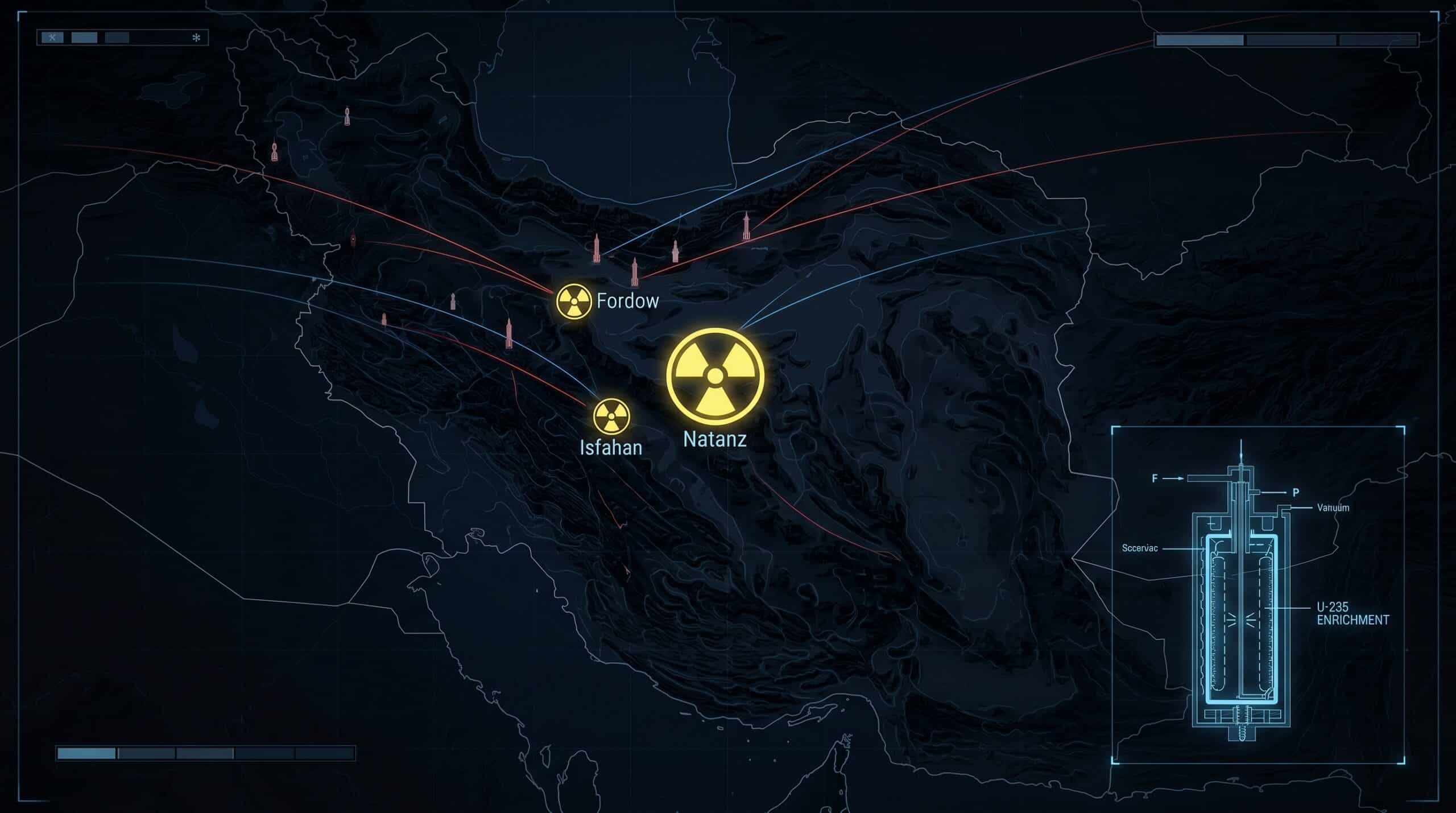
Iran operates several key nuclear facilities, including the Natanz enrichment plant, the Fordow underground enrichment facility, the Isfahan uranium conversion facility, and the Arak heavy water reactor. The Isfahan facility was among the targets struck during the 2026 US-Israeli operations, as documented on our 3D strike map.
Iran Nuclear Program Timeline: Key Milestones
- 1950s-1970s: Iran’s nuclear program began under the Shah with US support through the “Atoms for Peace” program
- 1979: Islamic Revolution. The program was initially suspended, then quietly restarted
- 2002: Iranian dissident group revealed secret enrichment facilities at Natanz and Arak, triggering international alarm
- 2006-2010: UN Security Council imposed multiple rounds of sanctions on Iran over its nuclear activities
- 2010: Stuxnet cyberattack (attributed to US and Israel) damaged centrifuges at Natanz, setting back enrichment by years
- 2015: The Iran nuclear deal (JCPOA) was signed. Iran agreed to limit enrichment to 3.67% in exchange for sanctions relief
- 2018: US President Trump withdrew from the JCPOA and reimposed sanctions. Iran began exceeding enrichment limits in response
- 2022-2025: Negotiations to restore the JCPOA repeatedly failed. Iran enriched uranium to 60%, approaching weapons-grade (90%)
- Early 2026: Geneva nuclear negotiations collapsed. IAEA reported Iran’s enrichment had reached levels with no plausible civilian purpose
- February 28, 2026: US and Israel launched strikes targeting Iran’s nuclear infrastructure and military sites
Why Did the 2015 Iran Nuclear Deal Fail?
The 2015 Joint Comprehensive Plan of Action (JCPOA) was considered a landmark diplomatic achievement. Under the deal, Iran agreed to reduce its uranium stockpile by 98%, limit enrichment to 3.67% (far below the 90% needed for weapons), reduce its centrifuge count, and allow extensive IAEA inspections. In return, international sanctions were lifted, allowing Iran to sell oil and access global financial systems.
The deal collapsed in stages. The US withdrawal in 2018 under President Trump was the critical blow. Without US participation, the economic benefits of the deal evaporated as European companies were forced to comply with reimposed US sanctions. Iran responded by gradually exceeding enrichment limits, arguing that the other parties had failed to uphold their commitments.
Multiple attempts to negotiate a replacement deal between 2022 and 2025 failed to bridge the gap between US demands for stricter terms and Iran’s insistence on guaranteed sanctions relief.
What Triggered the 2026 Iran Nuclear Strikes?
Several factors converged in early 2026 that led to the decision to use military force:
- Enrichment levels: Iran reportedly enriched uranium to levels approaching weapons-grade, with the IAEA expressing serious concern about the lack of civilian justification
- Diplomatic failure: The collapse of Geneva nuclear negotiations in February 2026 closed the last diplomatic channel
- Intelligence assessments: US and Israeli intelligence reportedly concluded that Iran was months away from having sufficient fissile material for a weapon
- Political alignment: The Trump administration and the Israeli government were aligned on a more aggressive approach than previous administrations
- Previous 2025 conflict: A 12-day air conflict between Iran and Israel in 2025 had already escalated tensions and established a precedent for military action
The strikes targeted nuclear facilities at Isfahan and other locations alongside military infrastructure. For the complete attack details, see our US-Iran conflict timeline.
Iran Nuclear Program and the Ceasefire Negotiations
The Iran nuclear program remains a central issue in the ongoing ceasefire negotiations. However, Iran has explicitly denied that any negotiations regarding the transfer of highly enriched uranium to America have taken place. This creates a significant obstacle to a comprehensive deal — the US and Israel launched the strikes specifically because of nuclear concerns, but Iran is reportedly unwilling to discuss the nuclear program as part of ceasefire terms.
The outcome of this standoff will determine whether the current de-escalation becomes a lasting peace or merely a pause before further conflict.
Iran Nuclear Program: Key Facilities
- Natanz — Primary uranium enrichment facility, central Iran (partially underground)
- Fordow — Underground enrichment facility near Qom, built inside a mountain for protection
- Isfahan — Uranium conversion facility (targeted in 2026 strikes)
- Arak — Heavy water reactor (modified under JCPOA)
- Bushehr — Nuclear power plant built with Russian assistance (civilian use)
What Does the Iran Nuclear Program Mean Going Forward?
The 2026 strikes damaged but did not destroy Iran’s nuclear infrastructure. Iran’s enrichment knowledge and technical capability cannot be bombed away — the expertise exists in the minds of Iranian scientists. This means that even if a ceasefire holds, the underlying nuclear question remains unresolved.
Possible outcomes include a new version of the JCPOA with stricter terms, a military occupation of nuclear sites (extremely unlikely), ongoing monitoring through the IAEA, or a tacit acceptance of Iran as a nuclear-threshold state similar to Japan (which has the capability but not the weapons).
Follow the latest developments in our daily SITREP reports and monitor the conflict in real time on our live dashboard.
Track the Conflict in Real Time
Live strike map, Hormuz status, and verified intelligence from the US-Iran conflict.
Open 3D Strike Map →