
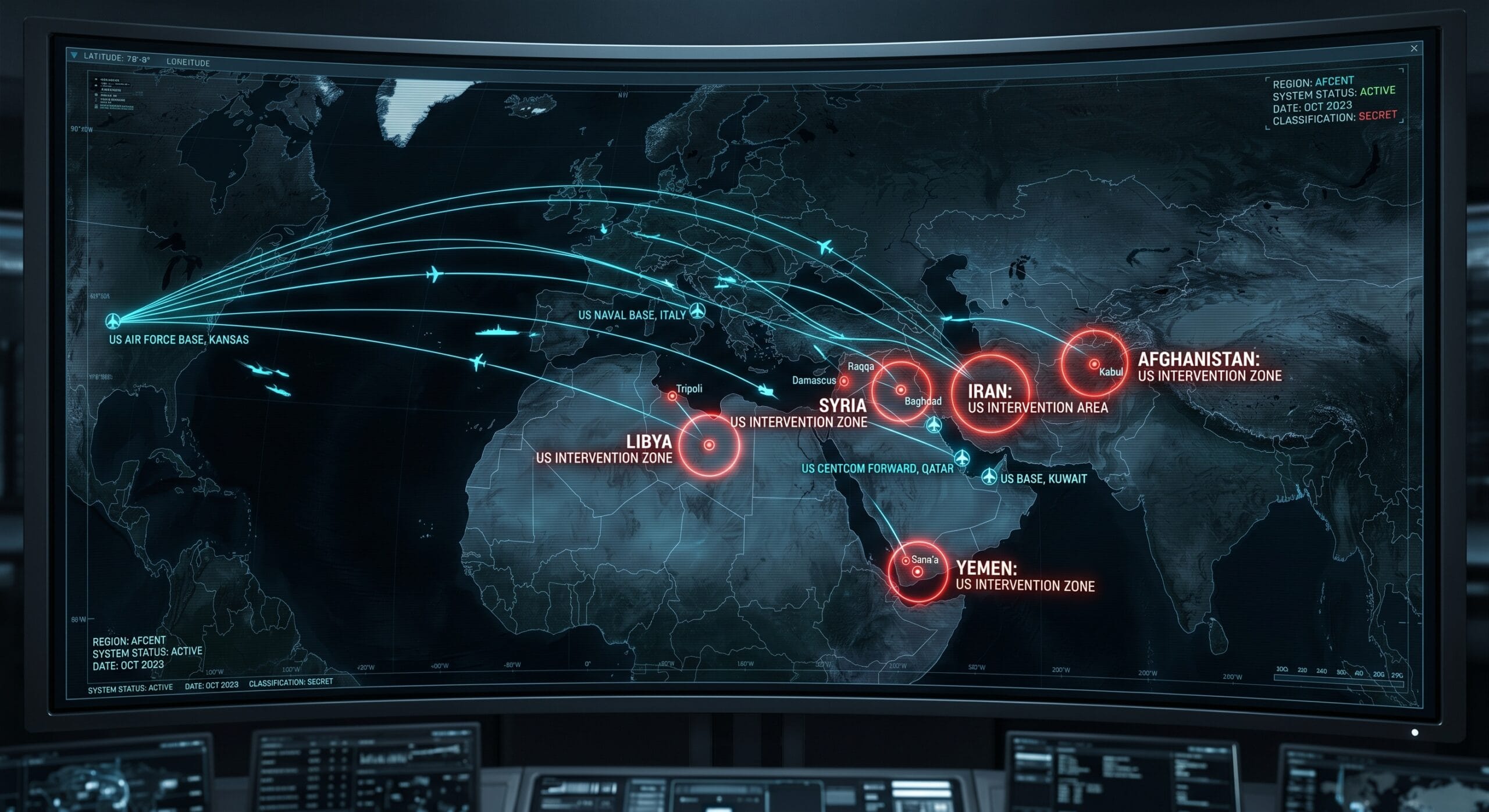
US Military Interventions Since 2001: Costs, Outcomes, and Lessons for the 2026 Iran War
US military interventions have shaped the Middle East and Central Asia for a quarter century. From Afghanistan to Iraq, Libya to Syria, and now Iran — the United States has launched major military operations in the region with vastly different justifications, strategies, and outcomes. As the 2026 Iran war enters its second month, the record of previous US military interventions raises critical questions about what strategic success looks like and whether the mistakes of the past are being repeated.
This article examines every major US military intervention since 2001, analyzes their costs and outcomes, and draws lessons relevant to the current conflict with Iran.
Major US Military Interventions Since 2001
Afghanistan (2001–2021)
The longest war in American history began after the September 11 attacks with overwhelming public support. The initial objective — toppling the Taliban and destroying al-Qaeda — was achieved within months. But the mission evolved into a 20-year nation-building effort that ended with the chaotic August 2021 withdrawal and the Taliban retaking power within days. The war cost over $2.3 trillion and resulted in approximately 2,400 US military deaths, 3,800 US contractor deaths, and an estimated 176,000 total fatalities including Afghan civilians, security forces, and Taliban fighters.
Iraq (2003–2011, 2014–present)
Launched on the premise that Iraq possessed weapons of mass destruction — later proven false — the Iraq War became the most controversial US military intervention of the 21st century. The initial invasion succeeded rapidly, but the subsequent occupation sparked a sectarian civil war, the rise of ISIS, and ultimately required a second US military intervention in 2014. Total cost exceeded $3 trillion. Over 4,500 US troops died, along with an estimated 200,000–300,000 Iraqi civilians.
Libya (2011)
A NATO-led air campaign, primarily driven by the US, UK, and France, helped rebel forces overthrow Muammar Gaddafi. The intervention was initially praised as a model of limited military action. But the absence of post-conflict planning led to state collapse, ongoing civil war, and Libya becoming a hub for weapons trafficking and migrant smuggling. President Obama later called the failure to plan for Libya’s post-intervention future his “worst mistake” in office.
Syria (2014–present)
US involvement in Syria included arming rebel groups, conducting airstrikes against ISIS, and maintaining a small military presence in northeastern Syria. The intervention achieved its stated goal of defeating ISIS’s territorial caliphate, but failed to remove the Assad government or end the Syrian civil war. The conflict produced the largest refugee crisis since World War II, with over 13 million Syrians displaced.
Yemen (2015–present)
US support for the Saudi-led coalition fighting Houthi rebels in Yemen included intelligence sharing, aerial refueling, and weapons sales. The war created what the UN called the world’s worst humanitarian crisis, with an estimated 377,000 deaths by 2022. US involvement was scaled back under pressure from Congress, but the conflict’s connection to the 2026 Iran war — the Houthis launched attacks on Red Sea shipping in solidarity with Iran — demonstrates how US military interventions create cascading regional consequences.
Iran (2026–present)
The current US military intervention in Iran began with coordinated US-Israeli airstrikes on February 28, 2026, targeting nuclear facilities and military infrastructure. Unlike previous interventions, there has been no ground invasion and no regime change objective has been stated. The stated goal is limited: degrading Iran’s nuclear capability. But the conflict has already expanded to include a naval blockade, Hormuz closure, multi-front proxy warfare, and a global energy crisis.
Afghanistan
Iraq
Libya
Iran (2026)
Patterns Across US Military Interventions
Several patterns emerge from examining two decades of US military interventions:
Initial Military Success, Long-Term Strategic Failure
In every intervention, the US achieved its initial military objectives quickly. The Taliban was overthrown in weeks. Saddam fell in 21 days. Gaddafi was deposed in 7 months. ISIS’s caliphate was dismantled. But in every case except the anti-ISIS campaign, the long-term strategic outcome was worse than the pre-intervention status quo. The 2026 Iran strikes similarly achieved their immediate military objective — damaging nuclear infrastructure — but the strategic consequences (Hormuz closure, global energy crisis, regional escalation) have been severe.
Mission Creep
Every major US intervention expanded beyond its original scope. Afghanistan went from counter-terrorism to nation-building. Iraq went from WMD elimination to democracy promotion to counter-insurgency. The 2026 Iran operation was described as a limited strike campaign, but has already expanded to include a naval blockade, proxy conflicts in Lebanon and Yemen, and a diplomatic crisis involving China and India over Hormuz access. Whether the Iran intervention follows the pattern of escalation seen in previous conflicts remains the central strategic question.
Underestimating Adversary Resilience
US planning consistently underestimated the adversary’s ability to absorb military strikes and adapt. The Taliban survived 20 years of US operations. Iraqi insurgents fought on for a decade. Iran’s response to the 2026 strikes — closing Hormuz, activating proxies, and seizing ships — demonstrated capabilities that Western intelligence reportedly underestimated. Iran’s willingness to absorb significant damage to its nuclear and military infrastructure while imposing severe economic costs on the global economy through Hormuz has complicated US strategic calculations.
How the 2026 Iran Conflict Differs From Previous US Military Interventions
Despite the patterns, the Iran conflict differs from previous US military interventions in important ways:
- No ground invasion planned — Unlike Afghanistan and Iraq, there is no US ground force deployed inside Iran. The operation is limited to airstrikes, naval operations, and cyber warfare. This dramatically reduces US casualty risk but also limits the ability to control post-strike outcomes
- Adversary has global economic leverage — Neither the Taliban, Saddam, Gaddafi, nor ISIS could inflict economic damage on the global economy. Iran’s control of the Strait of Hormuz gives it a weapon that causes more damage to the world economy than any conventional military capability
- Major power opposition — China and India have significant economic interests in Iranian oil and have opposed the US intervention diplomatically. This international dimension is more significant than in any previous US intervention
- Nuclear dimension — The war was triggered by nuclear concerns, and the risk of nuclear escalation — however remote — creates a strategic dynamic absent from previous conflicts
- Both sides want a deal — Unlike Afghanistan (where the Taliban wanted the US to leave) or Iraq (where there was no counterpart to negotiate with after Saddam’s fall), both the US and Iran have expressed willingness to negotiate. The ceasefire talks suggest this conflict may end differently than previous interventions
Lessons for the 2026 Iran War
The record of US military interventions offers several lessons relevant to the current conflict:
- Airstrikes alone rarely achieve lasting strategic objectives. The Libya precedent is instructive — air power can destroy military targets but cannot shape political outcomes
- Every intervention creates unintended consequences. The Iraq War created ISIS. The Libya intervention destabilized North Africa. The 2026 Iran strikes have already triggered a global energy crisis. Second and third-order effects matter more than first-order military results
- Exit strategy matters more than entry strategy. The failure in Afghanistan was not the initial invasion but the lack of a viable exit plan. The 2026 Iran conflict’s outcome depends on whether negotiators can construct a deal that both sides can accept — the military phase is the easy part
- Public support erodes with time and cost. Every prolonged US military intervention lost public support as costs mounted. The economic impact of the Hormuz closure is already affecting US consumers through higher fuel prices, creating domestic political pressure for resolution
For the complete conflict narrative, see our US-Iran conflict timeline. Track the military situation in real time on our 3D strike map and live dashboard.
Track the Conflict Live
Live strike map, Hormuz status, and verified intelligence from the US-Iran conflict.
Open 3D Strike Map →