
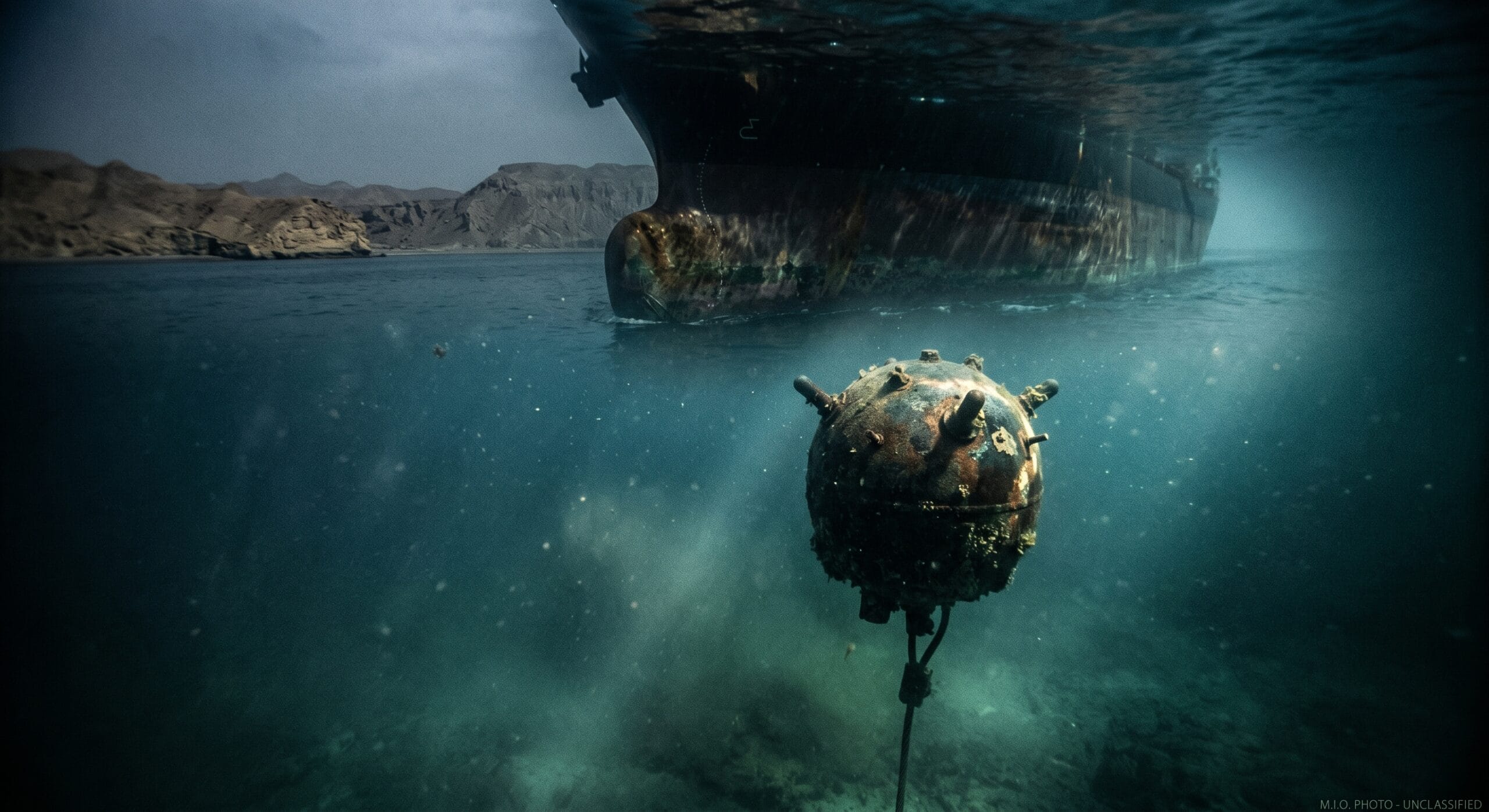
The Hormuz mines crisis is one of the most dangerous developments of the 2026 US-Iran conflict. Iran deployed Hormuz mines using GPS-guided systems and small IRGC boats, creating a deadly threat to global shipping. The Pentagon warned Congress that clearing Hormuz mines could take up to six months — even after the war ends. This guide covers everything about the Hormuz mines threat: how many Hormuz mines were deployed, what types of Hormuz mines Iran used, why clearing Hormuz mines is so difficult, and what the six-month timeline means for gas prices, oil markets, and global shipping through the Strait of Hormuz. The Hormuz mines situation has been called the greatest threat to maritime security since World War II.
Iran Mines Strait of Hormuz: Pentagon Says Clearing Could Take 6 Months
Iran mines in the Strait of Hormuz have emerged as one of the most dangerous and economically consequential elements of the 2026 conflict. On April 22, the Pentagon briefed Congress that clearing Iran mines from the Strait of Hormuz could take up to six months — even after the war ends. This assessment means that the economic impact of the conflict, including elevated gas prices and disrupted global shipping, could extend well into late 2026 or beyond.
This article explains what Iran mines are deployed in Hormuz, why they are so difficult to clear, what the Pentagon assessment means for global markets, and what mine countermeasure capabilities the US Navy has available.
How Many Hormuz Mines Has Iran Deployed?
According to intelligence assessments shared with Congress, Iran may have deployed 20 or more mines in and around the Strait of Hormuz since the conflict began. Iran is estimated to possess between 5,000 and 6,000 naval mines in its arsenal — one of the largest mine stockpiles in the world.
The mines deployed include several types with different detection challenges. Some are traditional moored contact mines that float at specific depths and detonate when a ship’s hull makes physical contact. Others are more advanced influence mines that detect the magnetic signature, acoustic noise, or pressure wave of a passing vessel and detonate without direct contact. Most concerning for mine clearance operations are remotely deployed mines that were reportedly floated into position using GPS guidance — making them extremely difficult to detect as they were being laid.
Iran Mine Arsenal — Key Facts
- Total estimated stockpile: 5,000–6,000 mines
- Mines reportedly deployed in Hormuz: 20+ (intelligence estimate)
- Types used: Contact mines, influence mines, GPS-guided remotely deployed mines
- Deployment method: Small IRGC boats, remotely floated via GPS
- Strait width: 34 km (21 miles) at narrowest point
- Shipping lanes: Two unidirectional lanes, each 3.2 km wide
- Daily oil transit (pre-war): ~20 million barrels per day
Why Hormuz Mines Are So Difficult to Clear
The challenge of clearing Iran mines from the Strait of Hormuz goes beyond simply finding and destroying them. As the US Naval Institute’s Proceedings journal explained in April 2026, modern mine warfare has fundamentally changed since the last major mine clearance operation in the Persian Gulf after the 1991 Gulf War.
The Detection Problem
Finding mines in a waterway is much harder than finding them on land. The Strait of Hormuz’s shipping lanes cover approximately 200 square miles. To ensure safe transit, mine countermeasure forces would need to clear two channels, each 2,000 yards wide, along the roughly 100 nautical mile shipping route. A single mine detected in the strait would compel planners to assume there are many more — and the task becomes not just finding mines, but proving their absence.
The GPS-Guided Mine Challenge
Iran reportedly deployed some mines by floating them into position using GPS technology rather than placing them from boats at specific locations. This makes tracking deployment extremely difficult because traditional surveillance of mine-laying vessels does not work — the mines float to their positions autonomously. Reports suggest Iran may have lost track of some of its own mines, meaning even Tehran cannot fully map the minefield.
The Operational Constraint
Mine clearance cannot safely proceed while active hostilities continue. US Navy mine countermeasure vessels are slow, lightly armed, and vulnerable to attack. They cannot operate effectively in a contested waterway where Iranian fast boats, anti-ship missiles, and coastal defense systems are active. This is why the Pentagon told Congress that clearance is unlikely to begin until the war ends.
What Mine Clearance Capabilities Does the US Have?
The US Navy’s mine countermeasure (MCM) capabilities include several systems, but analysts have raised concerns about their readiness and capacity for an operation of this scale.
- Avenger-class mine countermeasure ships: Wooden-hulled ships designed specifically for mine hunting and clearance. The US operates several, but not all are deployed to the Middle East
- Littoral Combat Ships (LCS): Independence-class LCS can be fitted with mine countermeasure mission packages, including the AN/AQS-20C sonar and Knifefish unmanned undersea vehicle (UUV)
- MH-53E Sea Dragon helicopters: Airborne mine countermeasure helicopters that can tow mine sweeping equipment behind them over suspect areas
- Unmanned systems: The Knifefish UUV and various unmanned surface vehicles (USV) designed for mine detection. These represent the future of mine warfare but are still being fielded in limited numbers
- Coalition partners: The UK, France, and several Gulf nations operate mine countermeasure vessels that could contribute to a clearance operation
The 6-Month Timeline: What It Means
The Pentagon’s assessment that clearing Iran mines could take 6 months has enormous economic and political implications:
- Oil prices: Even if a peace deal is signed tomorrow, Hormuz shipping cannot fully resume until mines are cleared. This means oil prices could remain elevated through late 2026
- Gas prices: American gas prices would remain above $3.50-4.00/gallon for months even after a ceasefire. Analysts project prices won’t return to pre-war levels until 2027
- US midterm elections: The November 2026 midterms would occur while mines are still being cleared and gas prices remain elevated — creating significant political pressure on the Trump administration
- Global supply chains: Industries dependent on Middle Eastern oil and LNG — including Asian manufacturing, European energy, and global shipping — face months of continued disruption
- Insurance costs: Maritime war risk insurance premiums for Hormuz transit, which surged from 0.125% to over 1% of hull value, would remain elevated until mines are confirmed cleared
Trump’s “Shoot and Kill” Order
On April 23, President Trump escalated the maritime confrontation by ordering the US Navy to “shoot and kill” any Iranian boats caught laying mines in the Strait of Hormuz. This order represents a shift from defensive mine clearance to active prevention of new mine deployments.
The order raises several questions. First, distinguishing between mine-laying boats and regular IRGC fast boats in real-time is extremely difficult — the same small boats Iran uses for mine deployment are also used for patrol, smuggling interdiction, and other routine activities. Second, firing on Iranian military vessels during an ostensible ceasefire could trigger a resumption of full-scale hostilities. Iran’s IRGC has already vowed a “strong response” to any military ships operating in the strait.
Historical Precedent: Mines in the Persian Gulf
Iran has used naval mines in the Persian Gulf before. During the Iran-Iraq War (1980-1988), Iranian mines struck several vessels including the USS Samuel B. Roberts in 1988, which nearly sank after hitting a mine. The US retaliated with Operation Praying Mantis — the largest American naval engagement since World War II. After the 1991 Gulf War, Iraqi mines damaged the USS Princeton and USS Tripoli, and mine clearance operations took months despite Iraq deploying far fewer mines than Iran’s current estimated stockpile.
The 2026 situation is more complex because Iran’s mines are more sophisticated than Iraq’s 1991-era weapons, the strait is longer and wider than the areas mined in previous conflicts, and the economic stakes are exponentially higher with 20% of global oil transiting the waterway.
Monitor the Hormuz situation in real time on our maritime tracker and track military developments on our 3D strike map. For the complete conflict background, see our Strait of Hormuz explainer.
Monitor Hormuz Shipping Live
Real-time AIS vessel tracking, Hormuz status, and conflict dashboard.
Open Maritime Tracker →