
UN Votes on Israel: A Data-Driven Look at Vetoes, Resolutions, and International Law
UN votes on Israel have been one of the most contentious and debated aspects of international diplomacy for decades. Critics argue that the United Nations disproportionately singles out Israel for condemnation while ignoring worse human rights abusers elsewhere. Defenders of the UN voting record argue that the volume of resolutions reflects the scale and duration of the Israeli-Palestinian conflict and the occupation of Palestinian territories. With the 2026 US-Iran war adding a new layer of complexity to UN deliberations, understanding the data behind UN votes on Israel has never been more important.
This article presents the factual record: the numbers, the vetoes, the key resolutions, and what they reveal about how the international system treats the Israeli-Palestinian conflict compared to other global crises.
UN Votes on Israel: The Numbers
UN General Assembly Resolutions on Israel
The disparity is stark. The UN General Assembly has passed more resolutions criticizing Israel than all other countries in the world combined. In a typical year, the UNGA passes approximately 15-20 resolutions on Israel versus single-digit resolutions on countries like Syria (where over 500,000 people have been killed in a civil war), North Korea (which operates prison camps holding an estimated 120,000 people), or China (which has been accused of detaining over a million Uyghurs).
This numerical imbalance is the primary evidence cited by those who argue that the UN applies different standards to Israel than to other nations. However, the counterargument is that the Israeli-Palestinian conflict involves a unique situation under international law — a prolonged military occupation that the international community has repeatedly declared illegal.
US Vetoes on Israel at the UN Security Council
The UN Security Council is where binding international decisions are made, and the veto power of the five permanent members (US, UK, France, Russia, China) determines which resolutions pass. The United States has used its veto to block resolutions on Israel more than any other topic.
US Vetoes Related to Israel
The United States has vetoed more Security Council resolutions on Israel than on any other subject. This pattern has been consistent across both Democratic and Republican administrations, reflecting a bipartisan US policy of shielding Israel from UN Security Council action. During the 2026 conflict, the US vetoed resolutions calling for an immediate ceasefire and condemning the strikes on Iran, while Russia and China vetoed counter-resolutions supporting the US position.
The Two Perspectives on UN Votes on Israel
Argument: The UN Disproportionately Targets Israel
Those who view the UN as biased against Israel point to several facts:
- Israel receives more UNGA resolutions than countries with far worse human rights records
- The UN Human Rights Council has a permanent agenda item (Item 7) dedicated solely to Israel — no other country has a standing agenda item
- The voting bloc of 57 Organization of Islamic Cooperation (OIC) member states plus the Non-Aligned Movement creates an automatic majority against Israel in the General Assembly
- Some UNGA resolutions have been criticized for one-sided language that fails to acknowledge Israeli security concerns or Palestinian Authority governance failures
- The volume of resolutions has not correlated with diplomatic progress — the conflict persists despite decades of UN attention
Argument: The Resolutions Reflect Legitimate Concerns
Those who defend the UN voting record argue:
- Israel has maintained a military occupation of Palestinian territories since 1967 — the longest active military occupation in modern history
- The International Court of Justice has ruled that Israeli settlements in the occupied territories violate the Fourth Geneva Convention
- The volume of resolutions reflects the duration and scale of the conflict, not anti-Israel bias
- Other countries face fewer resolutions because their situations are addressed through different mechanisms or because they do not receive the same level of diplomatic protection from a permanent Security Council member
- US vetoes prevent the Security Council from taking meaningful action, forcing the issue into the General Assembly where resolutions are non-binding but serve as expressions of international opinion
How the 2026 Iran War Changed the UN Dynamic
The 2026 US-Iran conflict has disrupted the traditional UN voting patterns on Israel in several ways:
Security Council Paralysis
During the 2026 conflict, the Security Council has been unable to pass any binding resolution. The US vetoed resolutions condemning the strikes on Iran and calling for an immediate ceasefire. Russia vetoed resolutions supporting the US-Israeli position. China abstained on several votes while calling for de-escalation. The result was complete Security Council paralysis — the body designed to maintain international peace was unable to address the largest military conflict in the Middle East in decades.
General Assembly Emergency Session
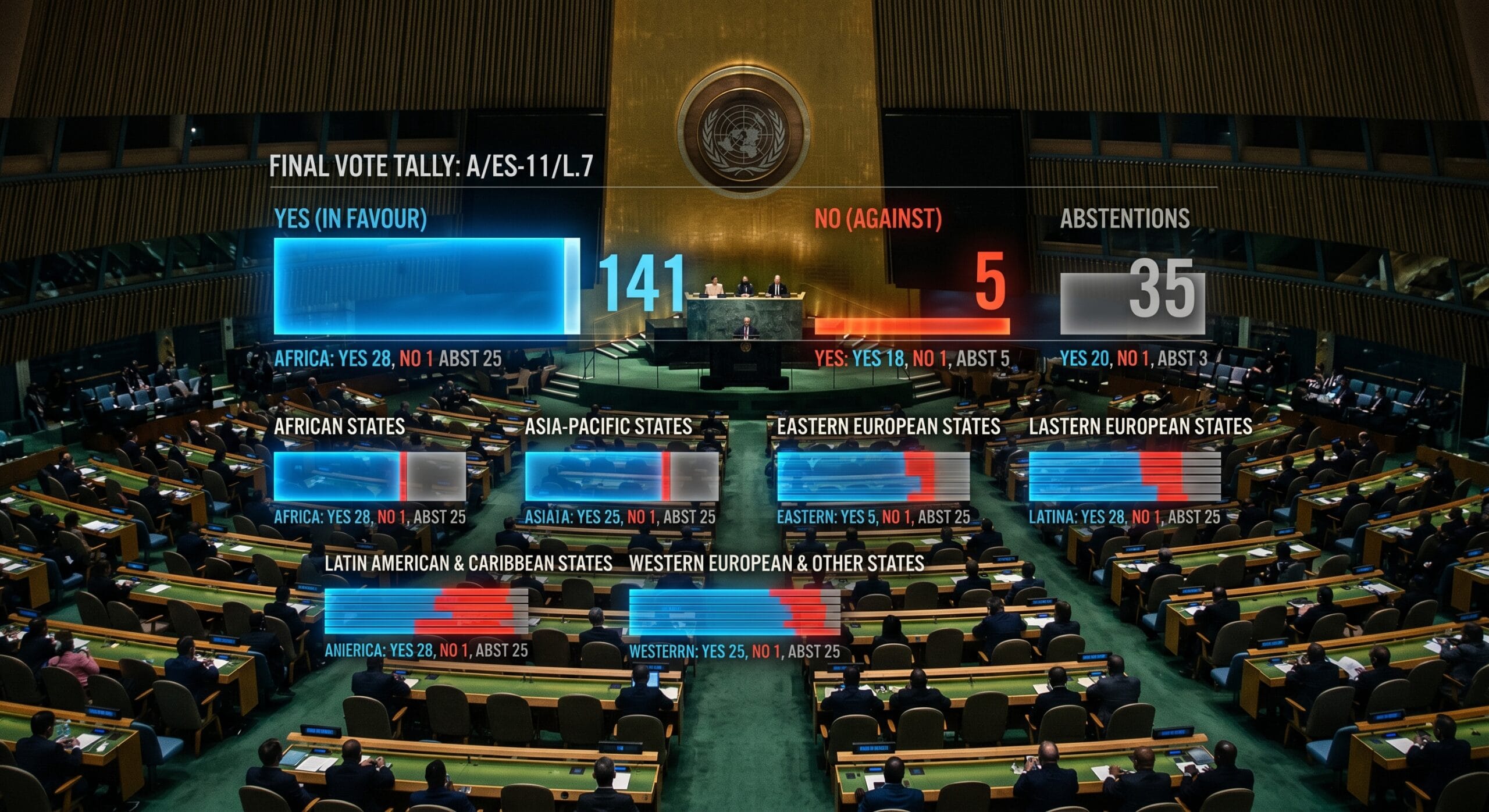
With the Security Council deadlocked, the UNGA convened an emergency special session on the Iran conflict. A resolution demanding an immediate ceasefire passed with over 140 votes in favor, with the US and Israel among a small number of opposing votes. While non-binding, the vote demonstrated the degree of international opposition to the military operation.
Hormuz Complicated Everything
Iran’s closure of the Strait of Hormuz introduced a complicating factor. Countries that traditionally voted with the Arab bloc against Israel found themselves caught between solidarity with Iran and their own economic interests in keeping the strait open. India, Japan, South Korea, and several Southeast Asian nations — all major oil importers — pressed for the strait’s reopening while simultaneously criticizing the strikes on Iran. This created unusual diplomatic alignments that broke from traditional UN voting patterns.
Key UN Resolutions in the Context of the 2026 War
- UNSC Resolution 242 (1967) — Called for Israeli withdrawal from territories occupied in the Six-Day War. Still cited as the basis for a two-state solution. Never enforced
- UNSC Resolution 338 (1973) — Called for a ceasefire in the Yom Kippur War and implementation of Resolution 242. Partially implemented
- UNGA Resolution ES-10/21 (2024) — Called for an immediate ceasefire in Gaza. Passed 153-10. Non-binding
- UNGA Emergency Session (2026) — Demanded immediate cessation of hostilities in Iran. Passed 143-9. Non-binding
- Bahrain draft UNSC Resolution (2026) — Called for forcible reopening of the Strait of Hormuz. Vetoed by Russia and China
What the Data Shows
The factual record of UN votes on Israel reveals a system with genuine structural tensions. The General Assembly voting pattern does show a statistical disproportion in attention directed at Israel compared to other conflicts. At the same time, the US veto pattern at the Security Council demonstrates an equally striking pattern of shielding Israel from binding international action.
Whether one interprets these patterns as evidence of anti-Israel bias or as a legitimate response to occupation depends largely on which data points one emphasizes. What is factually clear is that the current UN system has failed to resolve the underlying conflicts — the Israeli-Palestinian issue persists after 75+ years of UN attention, and the 2026 Iran war proceeded despite UN mechanisms designed to prevent exactly this type of escalation.
The 2026 conflict has, if anything, deepened the crisis of confidence in the UN system. The Security Council’s inability to act on the most significant Middle East military conflict in decades has reinforced calls for UN reform from nations across the political spectrum.
Follow the diplomatic dimension of the conflict in our daily SITREP reports and track the military situation on our 3D strike map.
Track Diplomatic and Military Developments
Live conflict dashboard with verified intelligence from multiple sources.
Open War Intel Hub →