
What Is ADS-B? How Aircraft Tracking Works in Conflict Zones
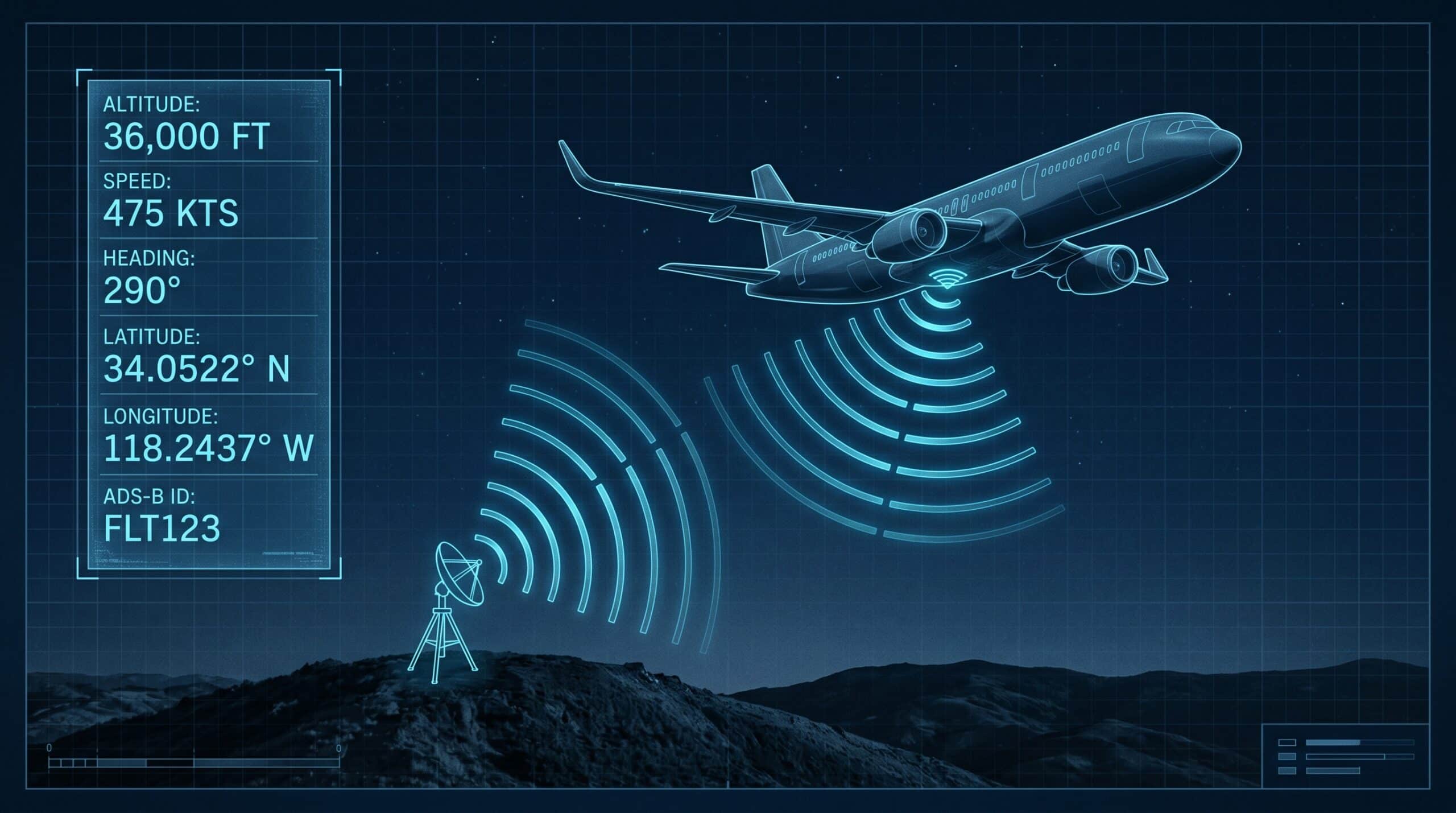
ADS-B is the technology that makes real-time flight tracking possible. If you have ever used Flightradar24 or our air traffic monitor to watch aircraft move across a map, you were looking at ADS-B data. During the 2026 US-Iran conflict, ADS-B tracking became a vital tool for OSINT analysts and the public to monitor airspace closures, military activity, and civilian flight disruptions over the Middle East.
This article explains what ADS-B is, how it works, why it matters for conflict monitoring, and what its limitations are when used in active war zones.
What Does ADS-B Stand For?
ADS-B stands for Automatic Dependent Surveillance-Broadcast. Breaking down each word reveals how the system works:
- Automatic — The system operates continuously without pilot input. Once the transponder is on, it broadcasts automatically
- Dependent — The system depends on the aircraft’s own GPS receiver for position data, rather than ground-based radar
- Surveillance — The purpose is surveillance of aircraft positions for air traffic control and safety
- Broadcast — The data is broadcast openly on the 1090 MHz frequency. Anyone with a receiver can pick it up
This last point is critical for conflict monitoring. Because ADS-B data is broadcast openly, not encrypted, anyone with a simple radio receiver (costing as little as $20) can track aircraft in their area. Networks of thousands of volunteer receivers worldwide, like the OpenSky Network, aggregate this data to create global flight tracking coverage.
What Information Does ADS-B Broadcast?
ADS-B Data Fields
- ICAO address — Unique 24-bit identifier for each aircraft (like a license plate)
- Latitude and longitude — GPS-derived position, accurate to approximately 10 meters
- Altitude — Barometric or geometric altitude in feet
- Ground speed — Speed over the ground in knots
- Heading — Direction of travel
- Vertical rate — Climb or descent rate in feet per minute
- Callsign — Flight number or registration (e.g., “UAE203” or “N12345”)
- Squawk code — Four-digit code assigned by air traffic control (special codes indicate emergencies)
This information is broadcast approximately once per second for ADS-B Out (the variant required by most aviation authorities since 2020). Our air traffic monitor polls the OpenSky Network API every 60 seconds and displays all aircraft broadcasting ADS-B over the Middle East conflict zone.
How ADS-B Is Used for Conflict Monitoring
During the 2026 US-Iran conflict, ADS-B data revealed critical intelligence that was often available before official announcements. OSINT analysts used ADS-B tracking to identify several key developments:
Airspace Closures
When Iran closed its airspace to commercial traffic after the first strikes, ADS-B data showed the change in real time. Aircraft that had been routing over Iran suddenly diverted around Iranian airspace, creating visible rerouting patterns on flight tracking maps. This was observable on platforms like our air traffic monitor hours before official NOTAMs were widely reported.
Military Staging
While most military combat aircraft fly without ADS-B transponders, military tankers and transport aircraft often broadcast ADS-B. Analysts observed unusual concentrations of KC-135 tanker aircraft orbiting near the Iranian border in the days before the strikes, suggesting aerial refueling operations in preparation for combat missions.
Civilian Impact
ADS-B data quantified the civilian impact of the conflict. Airlines added hundreds of miles to routes that normally crossed Iranian airspace, increasing fuel consumption and flight times. Some routes between Europe and Asia became significantly longer, directly impacting ticket prices and airline profitability.
ADS-B vs Radar: Key Differences
Traditional radar sends out radio signals and detects aircraft from the reflected signals bouncing back. ADS-B works differently — the aircraft itself broadcasts its position. This fundamental difference has several implications:
- Coverage — Radar requires expensive ground stations with line of sight. ADS-B receivers are cheap ($20-100) and can be operated by volunteers, providing coverage even in remote areas
- Accuracy — ADS-B provides GPS-level accuracy (meters). Radar accuracy degrades with distance and can be affected by terrain and weather
- Cost — A global ADS-B network costs a fraction of a radar network because receivers are simple and crowd-sourced
- Security — ADS-B signals are unencrypted, meaning anyone can receive them. This is a feature for transparency but a concern for military operations
- Dependency — ADS-B depends on the aircraft choosing to broadcast. Military aircraft can simply turn off their transponders to become invisible to ADS-B (but not to radar)
Limitations of ADS-B in Conflict Zones
Understanding what ADS-B cannot do is just as important as understanding what it can:
- Military aircraft often fly dark — Combat aircraft routinely disable transponders during operations. You will not see fighter jets, bombers, or stealth aircraft on civilian ADS-B trackers
- Spoofing and jamming — ADS-B signals can be spoofed (fake positions broadcast) or jammed (signals blocked). Both have been reported in conflict zones including the Middle East
- Coverage gaps — ADS-B depends on ground receivers. Over oceans, deserts, and remote areas of Iran, receiver coverage is limited. Satellite-based ADS-B (like Aireon) fills some gaps but data access is restricted
- No payload information — ADS-B tells you where an aircraft is, not what it is carrying or what it is doing. A transport aircraft could be carrying humanitarian aid or weapons — ADS-B cannot distinguish
For these reasons, experienced OSINT analysts always combine ADS-B data with other intelligence sources including ship tracking (AIS), satellite imagery, news reports, and official statements.
How to Start Tracking Aircraft with ADS-B
You can start monitoring ADS-B data immediately using free online platforms. For conflict-specific monitoring over the Middle East, our air traffic monitor is purpose-built with conflict zone overlays and focused on the Iran theater. For global tracking, Flightradar24 and ADS-B Exchange provide worldwide coverage.
For a detailed guide on using these tools effectively for conflict monitoring, read our article on how to track flights over Iran.
See ADS-B Data Live Over the Middle East
Real-time aircraft positions refreshing every 60 seconds with conflict zone overlays.
Open Air Traffic Monitor →