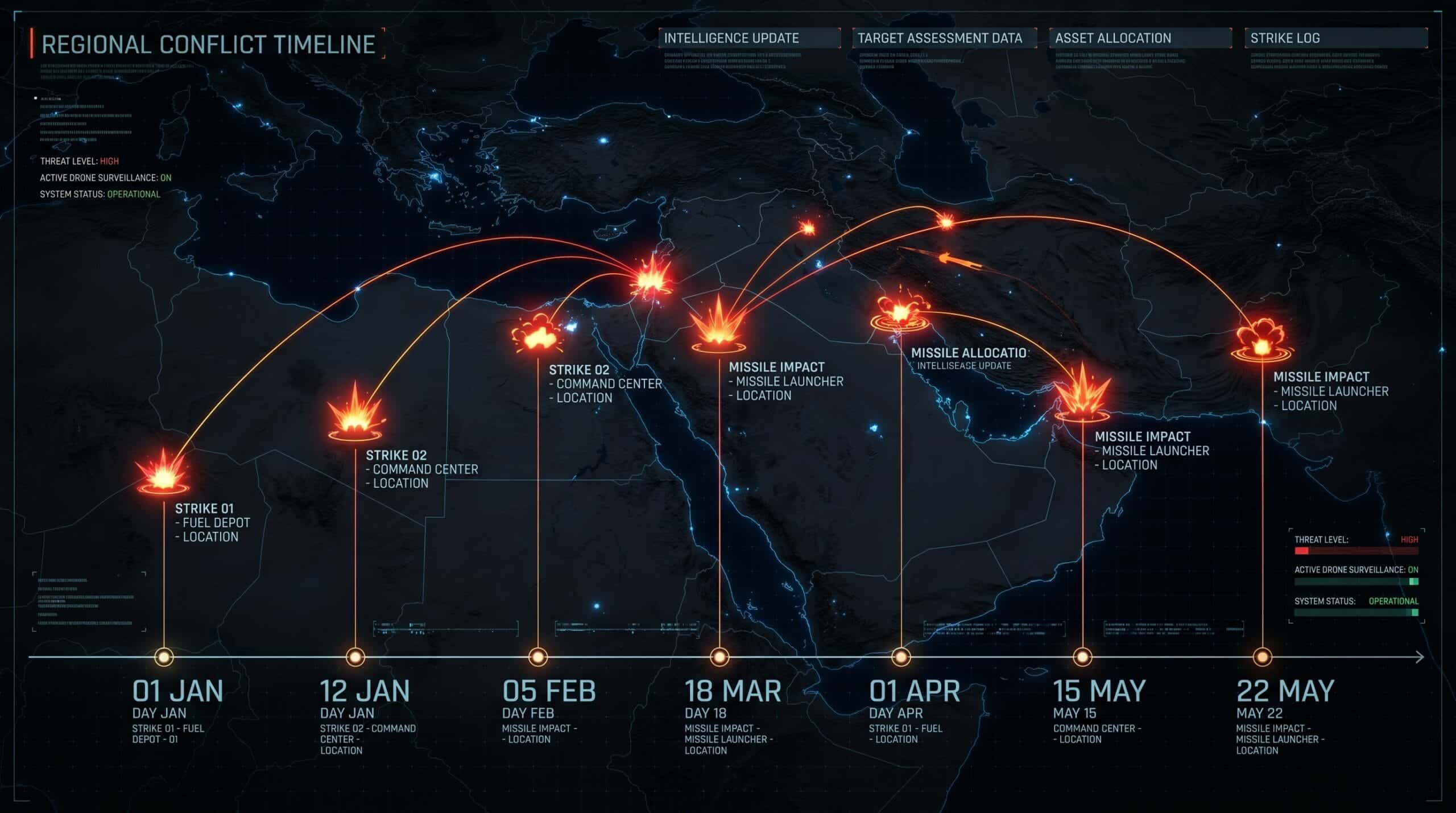
US-Iran Conflict Timeline 2026: Every Key Event From Day 1 to Ceasefire
Published: April 18, 2026
Updated: April 18, 2026
By War Intel Hub
10 min read
The US-Iran conflict timeline began on February 28, 2026, when the United States and Israel launched coordinated military strikes against Iran. What followed was the most significant military confrontation in the Middle East since the 2003 Iraq War — involving airstrikes across multiple Iranian cities, the closure of the Strait of Hormuz, naval engagements in the Indian Ocean, and retaliatory drone attacks on US bases in the Gulf.
This US-Iran conflict timeline tracks every major verified event from the first strikes through the ceasefire negotiations, based on reports from Reuters, AP, Al Jazeera, BBC, and official military statements. All events are classified using our 3-tier verification methodology.
Pre-Conflict Escalation (February 2026)
Early February 2026
Geneva nuclear negotiations collapse
Talks between Iran and Western powers over Iran’s nuclear program break down without agreement. Tensions escalate sharply as diplomatic channels narrow.
DIPLOMATIC15-20 February 2026
Iran accelerates oil exports in pre-conflict hedging
Iran reportedly tripled its oil export rate and reduced domestic storage, suggesting anticipation of imminent conflict. Saudi Arabia made similar moves. War risk insurance premiums for the Strait of Hormuz rose sharply.
NAVALWeek 1: Opening Strikes (Feb 28 – Mar 6)
February 28, 2026 — Day 1
US-Israeli coordinated strikes begin across Iran
Multiple waves of airstrikes reported targeting military and government facilities in Tehran, Isfahan, Qom, Kermanshah, and other cities. Iran’s supreme leader Ali Khamenei reportedly killed. The operation, reportedly codenamed “Epic Fury,” marked the beginning of the US-Iran conflict.
STRIKEMarch 1, 2026 — Day 2
Iran retaliates with drone strikes on Kuwait US base
IRGC launches drone attacks on US military facilities in Kuwait. DoD confirmed 6 US servicemembers killed — the first American combat deaths of the conflict. Additional strikes reported targeting Bandar Abbas naval facilities.
RETALIATIONMarch 2, 2026 — Day 3
Iran declares Strait of Hormuz closed; drones target Riyadh
IRGC officially confirmed the Strait of Hormuz closed to all commercial traffic. Iranian retaliatory drones targeted the US Embassy compound in Riyadh. No tankers broadcast AIS signals in the strait, indicating a near-total shipping halt.
RETALIATIONMarch 3, 2026 — Day 4
Israeli strikes on Beirut; Hezbollah infrastructure targeted
Israel expanded operations to Lebanon, striking reported Hezbollah infrastructure in Beirut and southern Lebanon. Exchange of fire reported along the Israel-Lebanon border.
STRIKEMarch 5, 2026 — Day 6
US submarine sinks Iranian warship off Sri Lanka
CENTCOM confirmed a US submarine engaged and sank the IRIS Dena in the Indian Ocean off Sri Lanka. Sri Lankan Navy reportedly recovered 87 bodies and rescued survivors. Lloyd’s of London removed war risk insurance coverage for the Strait of Hormuz.
NAVALWeeks 2-4: Escalation and Stalemate (Mar 7 – Mar 28)
The following weeks saw continued US-Israeli air operations against Iranian military targets, IRGC attacks on merchant ships attempting to transit the Strait of Hormuz, and escalating diplomatic tensions. Oil prices remained above $110 per barrel. The UN Security Council held emergency sessions but no resolution was passed due to vetoes.
Key developments during this period included reports of IRGC sea mines laid in the Strait of Hormuz, US deployment of additional carrier groups to the Persian Gulf, and Houthi attacks on shipping in the Red Sea in solidarity with Iran.
Track all verified events on our 3D strike map, which plots every approved strike with weapon type, casualty data, and source attribution.
Weeks 5-7: Diplomatic Track Opens (Mar 29 – Apr 17)
Early April 2026
US-Iran talks in Pakistan fail to reach breakthrough
Indirect negotiations between US and Iranian officials in Pakistan did not produce a ceasefire agreement. The US subsequently escalated with a naval blockade of Iranian ports in the Strait of Hormuz and the Gulf.
DIPLOMATICApril 10-14, 2026
UK and France organize multilateral maritime coalition
UK Prime Minister Starmer and French President Macron announced plans for a “defensive multilateral mission” to reopen the Strait of Hormuz, scheduling an international conference for April 17.
DIPLOMATICApril 16, 2026
Israel-Lebanon ceasefire announced
A 10-day ceasefire was agreed between Israel and Lebanon. It remained unclear whether Hezbollah would formally recognize the agreement. Trump stated Israel would no longer bomb Lebanon and was “prohibited from doing so by the U.S.A.”
CEASEFIREApril 17, 2026
Iran declares Strait of Hormuz “completely open”
Iranian Foreign Minister Araghchi announced the Strait of Hormuz open for all commercial vessels during the ceasefire period. Iran reportedly agreed to “never close the Strait of Hormuz again.” Oil prices dropped sharply on the news. Trump said a deal with Iran was “very close.”
CEASEFIREUS-Iran Conflict Timeline: Casualties and Impact
As of April 18, 2026, the conflict has resulted in significant casualties and economic disruption. According to Al Jazeera, more than 3,000 people have been killed since February 28. The US has confirmed 6 servicemembers killed in action. These figures remain subject to verification and may change as more information becomes available.
The economic impact has been enormous. The closure of the Strait of Hormuz disrupted approximately 20% of global oil supply, caused crude prices to surge over 40%, and triggered shipping insurance crises across the Gulf region. The full economic cost is still being calculated.
View the latest casualty figures and weapon counts on our live homepage dashboard, which pulls data directly from our verified strike database.
What Happens Next?
The US-Iran conflict timeline is still being written. While the Hormuz reopening and Lebanon ceasefire represent significant de-escalation, several key issues remain unresolved: Iran’s nuclear program, the US naval blockade of Iranian ports, and the broader question of a comprehensive peace agreement between Iran and the US-Israeli coalition.
Follow our daily SITREP reports for ongoing updates, and subscribe to receive intelligence briefings at 0600 UTC daily.
See the Conflict on a 3D Globe
Every strike, every retaliation, every naval engagement — visualized in real-time.
Open 3D Strike Map →